"Beirut Global Call"
National Network for the Protection of Libraries, Archives, and Cultural Heritage in Lebanon
Foundational Event
Friday, July 10, 2026, at 10:00 AM
National Library – Sanayeh
Subscribe for Updates and Announcements
Receive latest news about the conference and campaign.
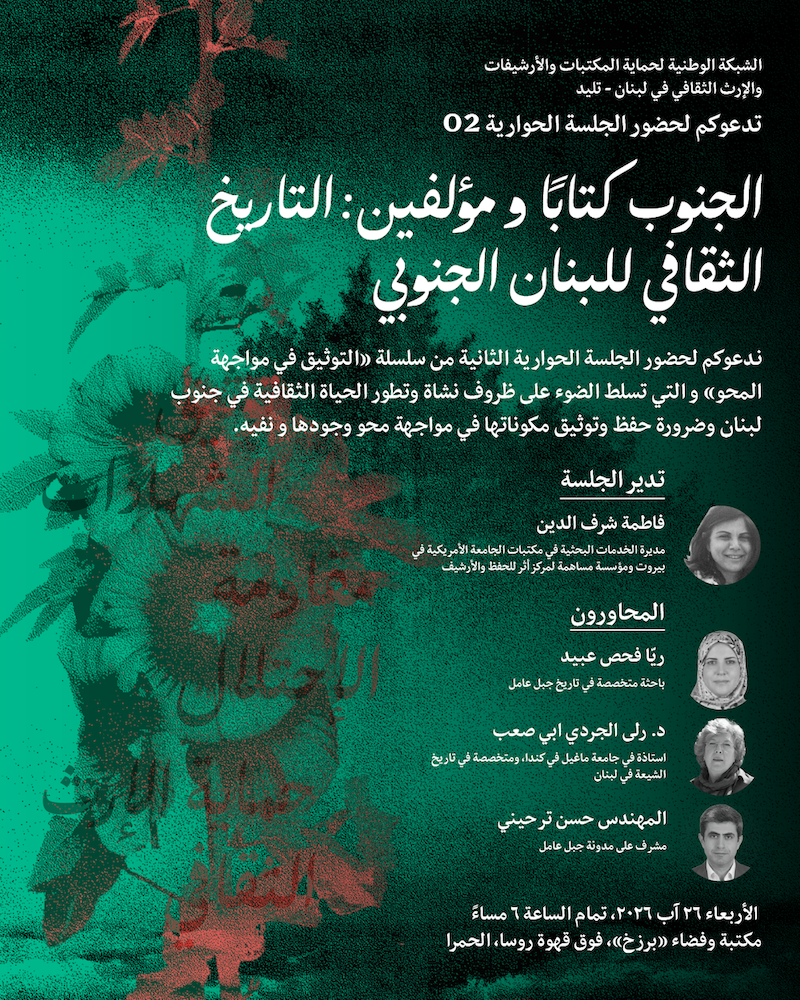
Upcoming Event — Dialogue Session 02
Southern Lebanon in Books and Authors: The Cultural History of Southern Lebanon
Dialogue Session 02
Date: Wednesday, August 26
Time: 6:00 PM
Location: Brzkh Library
About the session
The second dialogue session in the “Documentation Against Erasure” series sheds light on the conditions that shaped the development of cultural life in southern Lebanon, and the importance of preserving and documenting its components in the face of the erasure and denial of its presence.
Past Event — Dialogue Session 01
Documentation Against Erasure
Dialogue Session 01 — Series
Topic
A dialogue series on protecting cultural heritage and memory through documentation and archiving in the face of erasure and elimination policies. Highlights field and research experiences in documenting the destruction of cultural, architectural, and environmental heritage in southern Lebanon during 2024–2026, and the role of documentation and archiving in protecting memory and supporting recovery and reconstruction efforts.
Details
Date: Wednesday, July 29, 2026
Time: 6:00 PM
Location: Brzkh Library & Space, Assaf Building, 1st floor, Hamra Street, Beirut
Zoom Live Stream: Join the Session
Note: Due to technical problems, we will not be able to provide English interpretation.
Speakers
Joan Farshakh Bejjali
Lebanese archaeologist and journalist, founder of Biladi association
Betoul Yaseen
Architect and urban planner, projects coordinator at Lab for Cities – Beirut
Yara Abdel-Khalek
Engineer and urban researcher at Public Works Studio
About the Campaign
Global Call: Protect Lebanon's cultural heritage and the human memory of southern Lebanon
Today, we witness the systematic targeting of villages, homes, libraries, archives, and cultural centers in southern Lebanon. We witness repeated attempts to erase the physical and human evidence of Jabal Amel's history, memory, and knowledge. This erasure is not part of the war's collateral damage. It is a new chapter in the history of cultural and archival violence targeting memory as a testament to existence, rights, and belonging.
We, writers, poets, researchers, artists, publishers, librarians, archivists, academics, and cultural workers, raise this appeal in defense of the Lebanese cultural heritage and human memory threatened by the Israeli aggression against Lebanon, and the resulting targeting and destruction of public and private libraries, publishing houses, cultural centers, archives, manuscripts, documents, works of art, ancient houses, ancient olive trees, cultural sites, and places that nurture knowledge and memory.
This destruction is a direct assault on the memory of people and their right to knowledge, identity, and history. Private libraries, built over decades by individuals, intellectuals, and researchers, with their rare books, documents, correspondence, photographs, and manuscripts, constitute an integral part of human cultural heritage, and their loss means erasing pages from the collective Lebanese, Arab, and global memory.
Erasing archives is not merely a physical act, but a form of intellectual violence. When libraries are bombed, documents are burned, and homes that preserve photographs, letters, and manuscripts are destroyed, it is not only things that get erased; it is the ability of people to tell their history, prove their roots, and pass on their memories to future generations.
Culture is not a military target, and human memory is not a battlefield.
The Israeli aggression against Lebanon has thus far led to widespread destruction of libraries, archives, cultural and religious centers, and homes that hold repositories of memory, including private libraries, family albums, personal correspondence, local records, oral histories, and documents kept by individuals in their homes. The loss of these materials means the loss of an irreplaceable part of the social and cultural history of local communities, threatening the continuity of the cultural heritage and historical and cultural memory of southern Lebanon and Jabal Amel, with its profound civilizational, human, and intellectual significance in the history of Lebanon and the region.
The destruction of villages and towns, public and private libraries, archives, cultural centers, and homes with tons of explosives and their demolition by bulldozers—despite the manuscripts, documents, books, photographs, and works of art they house—constitutes an attempt to uproot the living evidence of this region's history and its cultural identity, accumulated over many centuries.
What is happening in southern Lebanon today cannot be separated from a longer history of cultural and archival violence in Palestine and Lebanon since 1948. It repeats the same pattern: targeting memory to delegitimize the landowners, erase evidence of their existence, history, and rights, destroy the conditions for human continuity, and attempt to sever the connection between land, memory, and identity.
This appeal is based on international principles and agreements that affirm the need to protect cultural heritage during armed conflicts, most notably: the 1954 Hague Convention for the Protection of Cultural Property in the Event of Armed Conflict, the 1970 UNESCO Convention, the 1972 World Heritage Convention, and international declarations and charters that consider the protection of culture and memory a shared human responsibility.
Targeting the cultural fabric of any people constitutes a violation of international humanitarian law and the universal values upon which human civilization is founded, and threatens cultural diversity and the right of future generations to access their history, knowledge, and intellectual output.
Silence in the face of attacks on cultural memory is not neutrality. When libraries are destroyed, archives are erased, and villages that hold people's memories, names, images, and documents are bombed, silence becomes a form of complicity in erasure. Therefore, we reject the double standards that condemn the destruction of heritage in certain places but ignore it when the victims are Lebanese, Palestinian, or other Arabs.
As people working in the fields of archives, libraries, museums, publishing, research, arts, and memory, we cannot treat this destruction as a local or transient matter, but rather as a protection of the world's cultural heritage and its diversity.
From here, we call upon international cultural, academic, and media institutions, national libraries and global library and archive associations, universities and publishing houses, human rights and cultural organizations, intellectuals, creators, and people of conscience worldwide to:
• Condemn the targeting of Lebanese cultural heritage, public and private libraries, and all forms of cultural destruction resulting from the aggression against Lebanon. • Protect Lebanon's cultural memory as a global humanitarian issue that transcends borders and political divisions. • Provide urgent international protection for the Lebanese cultural heritage as part of the human cultural heritage. • Support documentation, rescue, urgent protection, and archiving efforts for threatened libraries, archives, and cultural collections in southern Lebanon. • Launch international cooperation programs to restore and rebuild damaged libraries and cultural institutions. • Boycott official and private cultural and academic institutions that support the Israeli army "directly, or through silence, disregard, justification, or complicity" in its destruction of Lebanese and Palestinian libraries, printing presses, publishing houses, and archaeological sites. • Urge international professional associations, academic, archival, library, and museum institutions to issue clear statements against the destruction of cultural heritage in Lebanon and Palestine, and to reject silence or neutrality in the face of crimes of cultural erasure. • Support the creation of an emergency archive that documents the destruction of libraries, archives, heritage houses, and cultural and agricultural sites in southern Lebanon, and collects related photographs, testimonies, documents, maps, and audio-visual materials. • Support the right of local communities in southern Lebanon to preserve their memory and narrative in their own language and conditions, and not to confine their history to narratives of war and destruction, but rather to recognize it as a space of knowledge, culture, agriculture, thought, resistance, and life. • Review the methods for describing, archiving, and classifying materials related to southern Lebanon and Jabal Amel to ensure that the region's history is not reduced to war, security, or borders, but rather highlights its rich cultural, intellectual, agricultural, and social space. Protecting memory means not only rescuing documents from destruction but also describing them in their original language and context, with the dignity of their owners. • Launch an urgent call to the United Nations Educational, Scientific, and Cultural Organization (UNESCO) and relevant international institutions to send independent missions to assess and document the damage to libraries, archives, and cultural sites in southern Lebanon in accordance with international standards.
Lebanon, which throughout its history has been a space for books, thought, pluralism, and creativity, should not be left alone in the face of attempts to erase its cultural memory.
South Lebanon, with its rich intellectual, agricultural, social, and cultural history, is not a geographical periphery or a fleeting battleground, but rather a space of memory, knowledge, and life. Protecting its cultural heritage is protecting a fundamental part of Lebanon's and the region's memory, and indeed, of our shared human memory.
We believe that culture can resist destruction and that protecting cultural heritage is a global moral and humanitarian responsibility.
In essence, this appeal is a call for us to exercise our moral and professional responsibility in the face of erasure, to protect memory from cultural annihilation, and to stand clearly on the side of the right of peoples to their history, their land, their knowledge, and their archives.